Modern observability is no longer a tooling discussion for engineering teams.
For most organisations, it now touches platform strategy, cost control, security alignment, data reuse, and long-term operating discipline. That is why the need to establish credible modern enterprise observability tools is so vital in the current business landscape. These platforms can go a long way in helping teams work across logs, metrics, and traces. Among the large selection of choices in the market, Grafana and Elastic are highly effective in their roles. And while their initial goals may be similar, their deeper unique offerings become more recognisable.
While Grafana is built for observability-first flexibility, Elastic aims for broader platform unification across observability, security, and data architecture. That distinction shapes everything that follows, from how telemetry is stored, to how teams collaborate, to how costs behave over time, and will inform a long-term decision about what kind of platform model your organisation wants to run. Do you want a composable observability stack centred on visualisation and separate telemetry backends? Or do you want a broader platform where observability can connect with security, analytics, and wider operational intelligence?
Ultimately, that choice It will influence architecture, governance, and how well your teams scale with complexity. The real decision is whether the business needs a flexible observability layer or a unified observability platform that can support a wider strategy.
A Quick Glance at the Grafana vs Elastic Debate
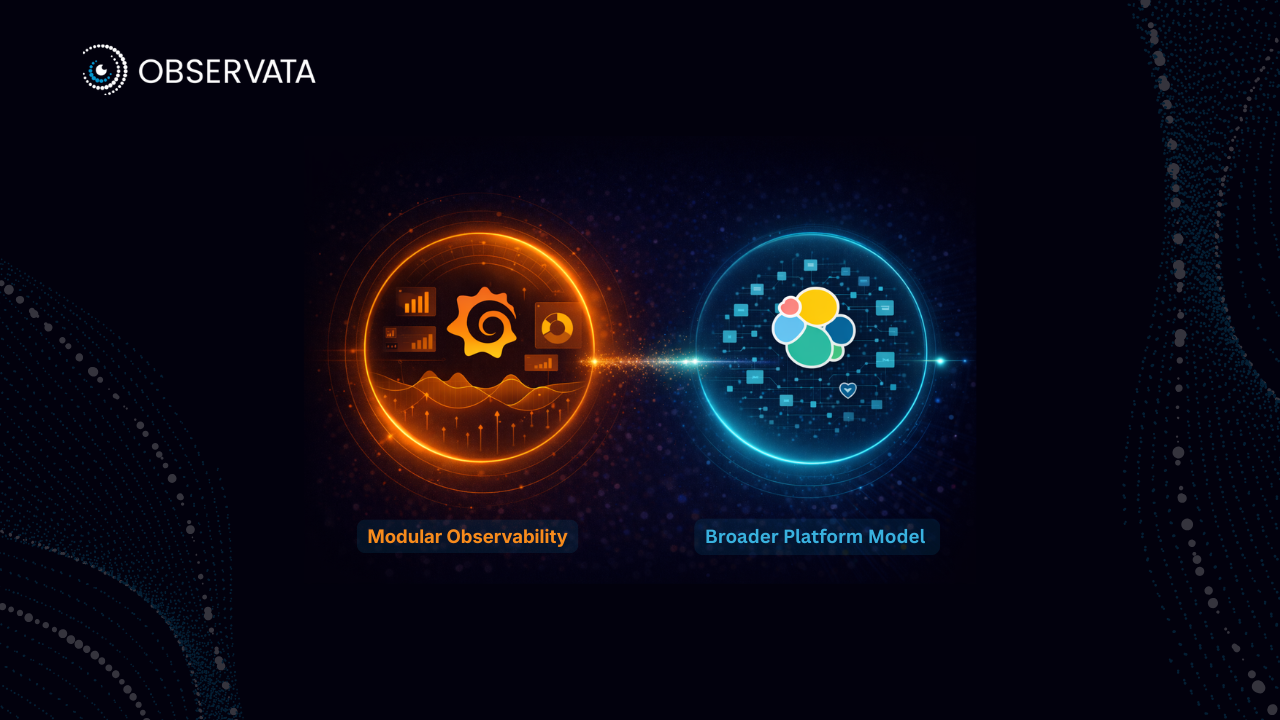
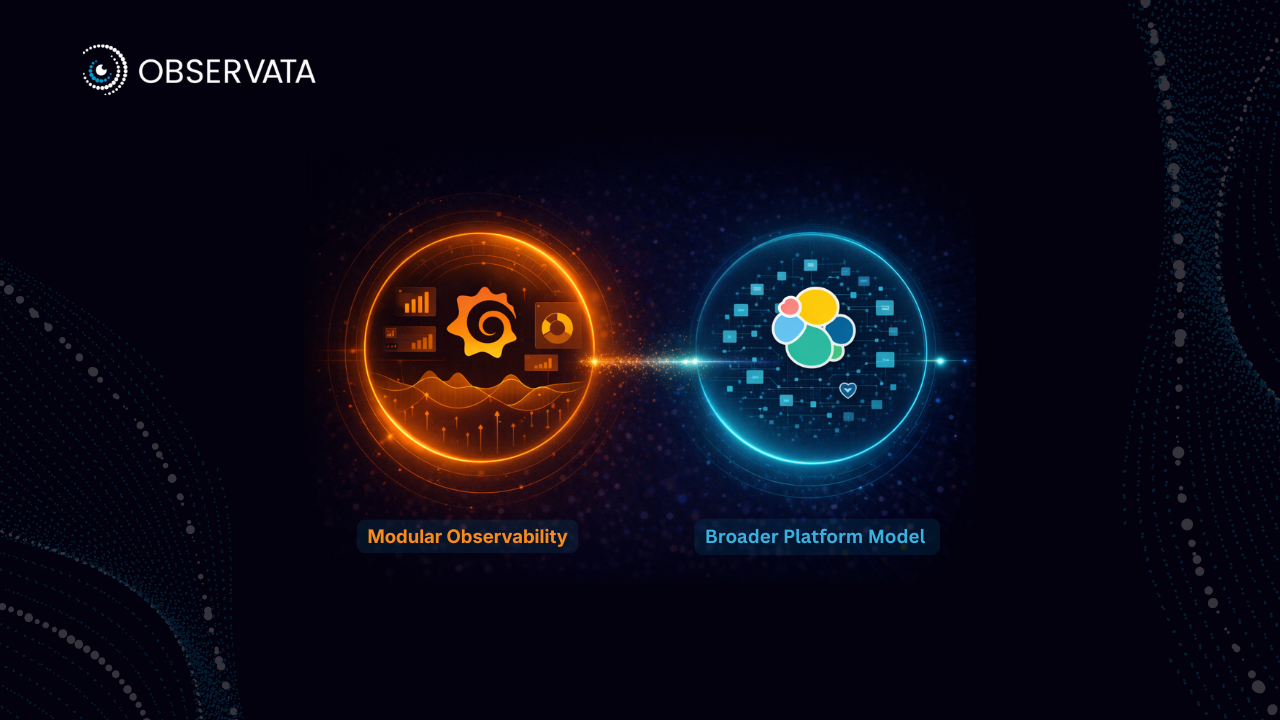
At its core, the Grafana observability stack is built for modular flexibility, while Elastic observability sits inside a broader platform model.
Grafana is often the better fit when teams want to build observability from specialised components and retain engineering flexibility. Elastic is often the better fit when the business wants observability to sit inside a wider platform strategy that includes security, analytics, and shared data architecture.
Here is the simplest way to view the difference:
Comparison Area
Grafana
Elastic
Core Model
Modular observability stack built around Grafana, with separate products such as Loki, Tempo, and Mimir
Unified platform for logs, metrics, traces, search, alerting, analytics, and security
Best Fit
Teams focused mainly on observability and engineering flexibility
Teams that want observability to support security, analytics, and broader data architecture
OpenTelemetry
Supports logs, metrics, and traces through separate but connected components such as Loki, Mimir, and Tempo.
Supports logs, metrics, traces, user experience, and broader telemetry in one integrated platform
Query Language
Uses different query approaches across components, including PromQL for metrics and LogQL for logs
Uses Elasticsearch Query DSL, ES
Security Capabilities
Primarily an observability decision; security usually sits in external tools
Extends into SIEM, security analytics, endpoint visibility, and shared SecOps workflows
Data Strategy
Strong for observability-focused workflows
Strong for ingest-once, reuse-across-operations-and-security workflows
Pricing
Can work well for focused observability use cases and selective scaling
Better evaluated at platform level, especially when consolidation matters
Technical Trade-Offs
More flexibility through modularity, but more moving parts to manage
More unified control, but stronger platform architecture knowledge needed
Ideal Use-Case
Better fit for teams comfortable running multiple observability components
Better fit for teams that want one platform and can invest in architecture and lifecycle management
Enterprise Advantage
Good when observability is the main requirement
Stronger when long-term consolidation, governance, and cross-team reuse matter
Now let’s get into what that means in practice.
Considering migrating from Grafana to Elastic? Observata can help.
Logs, Metrics, and Traces: Differentiating Operating Models
Both Grafana and Elastic support the three core pillars of observability: logs, metrics, and traces. But that is not where they diverge: they diverge in how they expect your teams to collect, manage, and use that telemetry.
The Grafana observability stack is commonly deployed as a modular setup. In many environments, that means the following components are in play accordingly:
- Grafana for dashboards and visualisation
- Loki for logs
- Tempo for traces
- Mimir for metrics
Grafana documents these as separate but connected parts of the Grafana stack. That model gives engineering teams flexibility. Components can be scaled independently. Teams can shape the stack around their own preferences. Observability stays close to specialist workflows and tool-level control. That appeals to teams that want observability without committing to a broader platform model.
Elastic takes a different path. Elastic observability handles logs, metrics, traces, dashboards, search, and alerting within one integrated platform. That matters because it enables a different data strategy. With Elastic, telemetry can be ingested once and reused many times. The same logs, metrics, or traces can support monitoring, troubleshooting, analytics, and security workflows without being pushed through separate architectures.
For leadership teams, the implication is simple: Grafana supports a tool-first observability model. Elastic supports a platform-first data model. If observability is primarily an engineering concern, Grafana can be a strong fit. If observability data needs to support wider operational goals, Elastic may align better with that broader mandate.
Comparing Operating Models Rather than Just Entry Costs
Pricing discussions around enterprise observability tools often go wrong when buyers compare only entry cost instead of long-term operating model. Too often, teams compare surface-level pricing, initial licensing, or one product line item. That creates a distorted view of cost.
Grafana can work well for focused observability use cases because pricing can be broken out across products and telemetry usage. That can make the commercial entry point look more manageable for teams that only want to scale certain parts of the stack. Grafana’s pricing and product structure support that modular model.
Elastic should be evaluated differently. Elastic pricing makes more sense when viewed at both the platform level and at the observability line-item level. As a resource-based platform tied to broader architecture and data strategy, Elastic offers cloud-hosted, serverless, and self-managed options as part of its core offerings.
The question is not simply, “Which one has the lower starting price?”
Instead, the better questions to ask are:
- Who owns observability in our organisation and how does your platform support that ownership across teams?
- What happens during an incident when more people need access, context, and history
- Does the tool enable collaboration, or does it slow it down?
- How does your pricing model change behaviour over time?
- What will teams hesitate to collect, retain, or query once usage grows?
- How easy is it to adapt the platform as systems, teams, and workloads evolve?
- Does it scale with complexity, or fight it?
- What does observability look like after six months of real usage?
A lower entry price is not always a lower long-term operating cost. A focused observability stack can look efficient in the first phase, then become more expensive as environments grow, teams multiply, and adjacent use cases emerge. A broader platform can look heavier at first, but create savings through reuse, consolidation, and fewer silos. Ultimately, pricing is only truly meaningful when viewed in the context of architecture, scale, and future platform scope.
Flexibility, Control, and Enterprise Reality
Grafana’s modular architecture gives teams flexibility. That is one of its biggest strengths. It allows engineering teams to choose different telemetry backends, scale them independently, and build observability in a way that reflects internal preferences. That makes Grafana attractive for organisations that want an open, composable approach centred on specialist tooling.
But modularity has a cost. More components mean more storage planning, more backend coordination, more pipelines, more integration work, and more responsibility for making the system behave as one coherent environment. This is where certain enterprise observability tools begin to reveal their real differences.
Elastic offers a more unified architecture. That gives organisations stronger control over:
- ingestion pipelines
- retention policies
- storage behaviour
- schema consistency
- data reuse across multiple use cases
There is a deeper executive question to consider as well: What kind of control does the enterprise need over its telemetry environment?
Grafana can be the right answer when the organisation values engineering-driven flexibility across separate observability components. Elastic may be the better fit when the organisation wants a unified observability platform that offers a more centralised model for governance, broader reuse of operational data, and more direct control over how telemetry is retained, queried, and extended.
Neither model is wrong. But they support very different operating assumptions.
Skill Gaps, Support, and Service Reality
This is often one of the most underestimated aspect of choosing an observability platform. Implementation is not the finish line: it is the start of the real work. On one hand, the Grafana observability stack can reduce frontend friction, but the wider setup could introduce complexity across the multiple components in the stack. That creates a skills requirement around integration, backend coordination, storage design, query behaviour, and cross-component troubleshooting. On the other hand, Elastic observability can reduce platform sprawl, but it often demands stronger internal capability around ingestion, lifecycle management, optimisation, and long-term architecture.
For enterprises, the implication is clear: the platform “choice” is only half the decision. The other half is whether the organisation can run it, govern it, optimise it, and evolve it over time. That is where external partners and service providers like Observata can add real value: by bringing platform expertise, operating discipline, and ongoing optimisation support that internal teams may not always have the time or depth to maintain on their own.
Many platforms underperform not because they lack features, but because adoption stalls, architecture drifts, ownership fades, and optimisation never happens. Grafana may require stronger coordination across components, while Elastic may require stronger platform architecture and lifecycle management. In both cases, long-term value depends on whether the platform is actively scaled and supported rather than simply deployed and left in place.
What Elastic Offers Beyond Observability
While the Grafana observability stack is primarily an observability-led platform, Elastic can also support broader security and data needs. Even as a pure observability tool, Elastic offers out-of-the-box integrations with existing stacks, including AWS and Azure while also supporting on-premises and data-sovereign deployments for organisations with stricter infrastructure requirements – a particularly important requirement for Nordic industries. Some of Elastic’s extended capabilities include:
- SIEM
- security analytics
- endpoint-related visibility and workflows
- cross-team data correlation
- broader shared use of telemetry across operations and security
Elastic’s extended positioning matters because it allows teams to work from a shared data perspective. Logs collected for platform monitoring can also support threat detection, incident investigation, and security operations. At enterprise scale, that is less about product breadth and more about reducing silos across teams and workflows.
When observability and security sit on separate platforms, organisations often end up with parallel pipelines, duplicated storage, fragmented ownership, and a harder-to-manage operating model. That said, this does not make Grafana a weak choice. It simply means the two platforms serve different scopes. Grafana remains well suited to organisations that want focused observability with modular flexibility. However, for businesses looking for a unified observability platform that can also support security and shared operational data, Elastic’s broader scope becomes more relevant for their needs.”
A Final Snapshot
Grafana Observability Stack
Pros
- Flexible observability model with strong dashboarding and visualisation roots
- Good fit for engineering-led teams that want modularity and control
- Works well when observability is the primary requirement
- Allows selective scaling across separate observability components
Cons
- Broader setups can introduce more moving parts
- Cross-component coordination can increase operational overhead
- Security and wider data workflows often require separate tooling
- Long-term governance can get harder as the stack expands
Elastic Observability
Pros
- Unified platform for logs, metrics, traces, search, analytics, and security
- Strong fit for organisations seeking consolidation and cross-team data reuse
- Flexible deployment model across cloud, hybrid, and controlled environments
- Supports a wider platform strategy beyond observability alone
Cons
- Broader platform scope can require stronger architectural planning
- Teams may need more expertise around ingestion, lifecycle, and optimisation
- Can be more than some organisations need if observability is the only goal
- Full value often depends on disciplined implementation and ongoing operating support
Conclusion
At the end of the day, the “Grafana vs Elastic” debate is not something as simple as a dashboard comparison. Grafana and Elastic are both strong platforms, but they solve different business problems.
For many organisations, the better observability decision is not only about which platform to buy, but about which operating model will sustain value over time. Observability as a Service (OaaS) addresses that gap by combining platform capability with expert-led delivery, continuous optimisation, and shared ownership of outcomes. Through this model, service providers like Observata help enterprises move beyond installation and into a more durable observability practice — one that is designed to scale, adapt, and stay aligned with business needs.
Ultimately, do you want a modular observability layer, or do you need a unified observability platform that can support security, analytics, and broader operational strategy over time?
That is the real question to consider. And that is why this decision belongs in a strategic conversation, not just a technical one.
If you are evaluating how a unified observability platform should fit into your wider platform strategy, Observata can help you assess the architecture, operating model, and service approach needed to make that investment deliver long-term value.